

InfiniTex. The ERP that thinks in rolls, shades and grades.
A complete textile manufacturing suite built on ERPNext: roll-level inventory, revealed-yield costing, color science and machine-lane planning, written from 25+ years on the mill floor. Arabic-first, fiber to finished home textile.
- Textile DocTypes
- 74
- Planning boards
- 6+1
- Textile-math functions
- 37
- Arabic and RTL
- 100%
Generic ERP is built on four assumptions. All four are false in textile.
Inventory is not a number on an item: the atom is the roll. BOM yields are not known in advance: grades appear after inspection. Item codes do not exist before production: identity is discovered at runtime. And BOMs are not typed in: the construction computes them. InfiniTex re-models all four at the core. That is why mills that run generic ERP keep the truth in Excel, and mills that run InfiniTex do not.
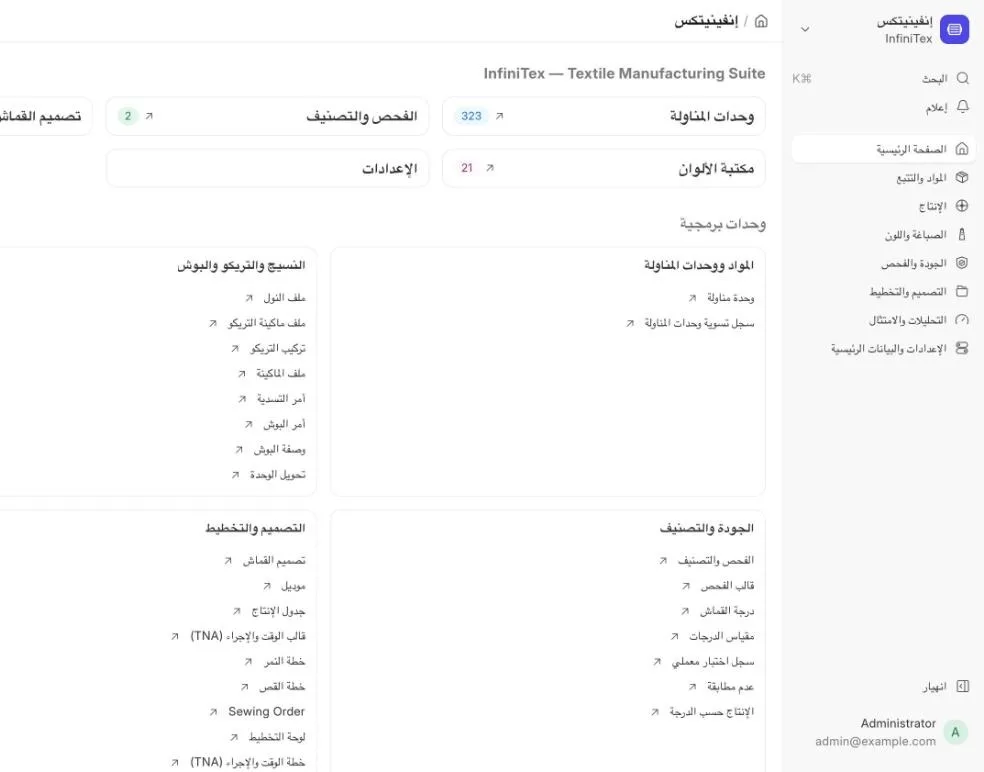
The kernel: handling units
Inventory the way the mill floor actually sees it
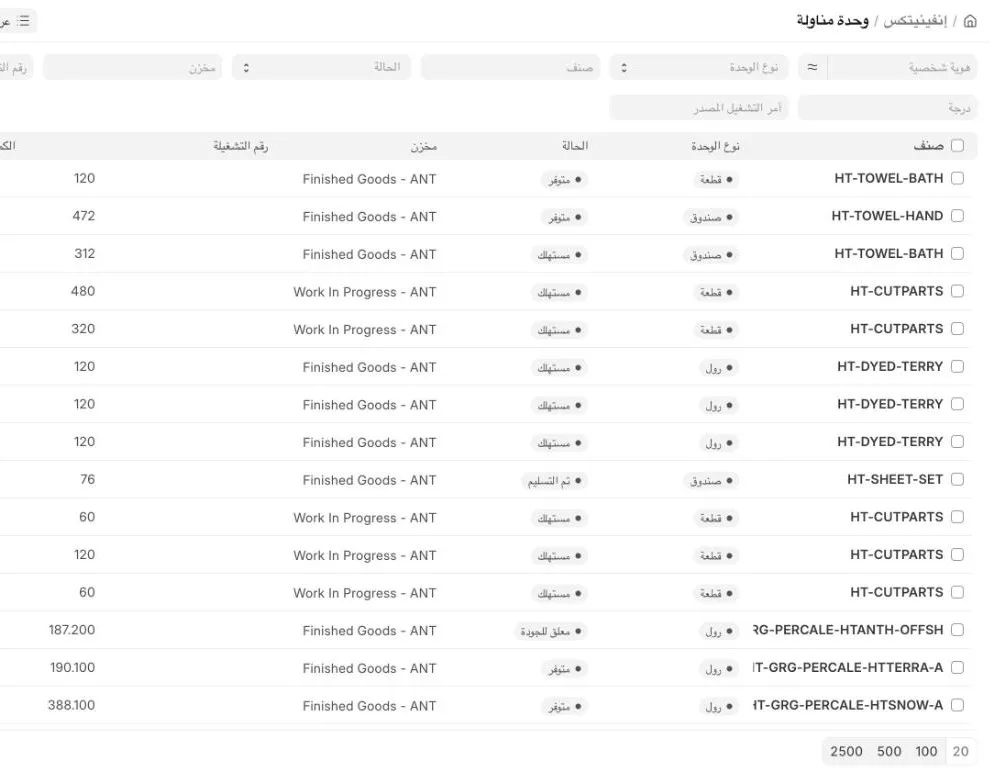
Generic ERP counts meters on an item. InfiniTex tracks the physical unit: every roll, cone, beam and pallet is a live record with its own actual length, weight, width, shade lot, grade and a positional defect map. A hard invariant keeps the sum of units identical to the stock ledger on every single voucher, so the unit truth and the accounting truth can never drift apart.
- Rolls, cones, beams, pallets, boxes and piece bundles, barcode-native
- Split, merge and transform with full parent-child genealogy
- Σ handling-unit qty ≡ stock-ledger qty, enforced at submit and cancel
Generative design: textile math
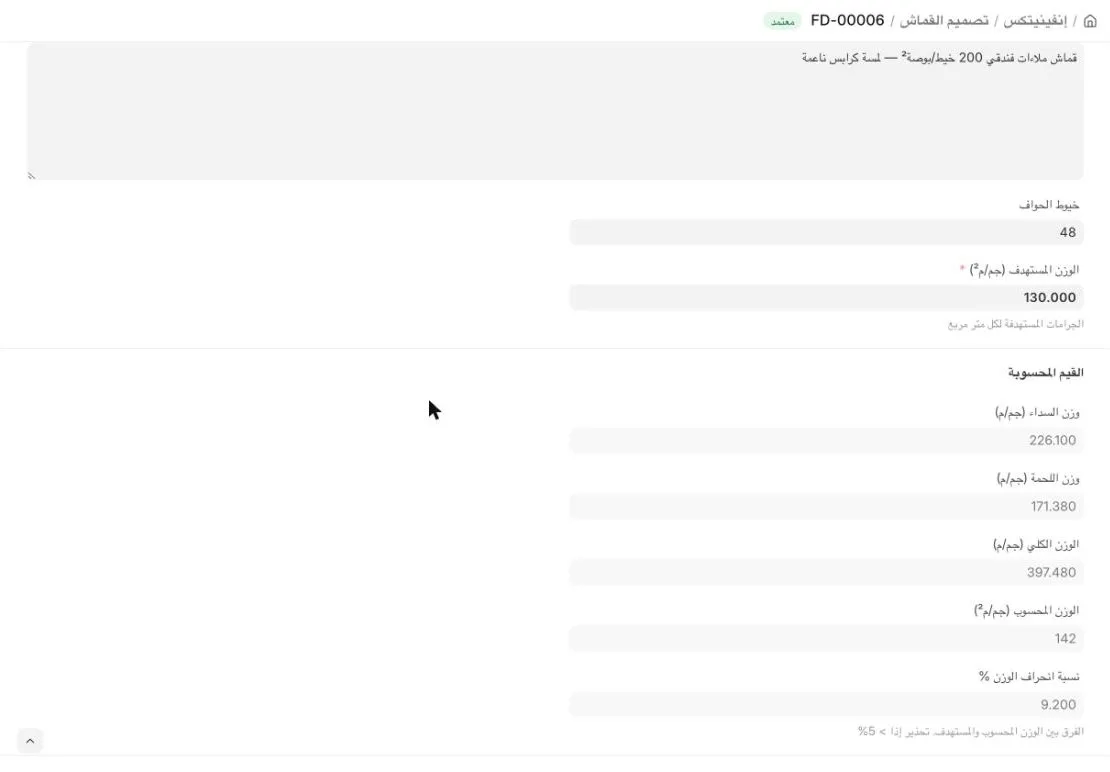
The construction generates the BOM
Enter a fabric the way a textile engineer thinks (counts, ends, EPI/PPI, crimp, sizing add-on, waste) and InfiniTex computes warp and weft grams per meter, GSM against target and per-colorway yarn demand, then generates the ERPNext BOM. Behind it sits a dedicated calculation engine: 37 pure, unit-tested functions citing textile standards, from Ne/Nm/Tex conversions to loom capacity and 4-point quality math.
- Woven, knit and terry constructions with live GSM deviation alerts
- Count conversions, crimp, realization %, points/100 yd², all standards-cited
- Design library with colorways, lab-dip and strike-off approval pipelines
Grading: revealed yield
Costing that follows the inspection table
In textile, yield is revealed, not designed. A work order's output collapses into grades A, B, C and rags only after 4-point inspection. InfiniTex creates the graded variant items at that moment (race-safe, vocabulary-governed) and splits the joint cost across grades by net realizable value in one clean stock entry. Yield profiles then learn the real grade distribution and drive gross-quantity planning upstream.
- 4-point inspection with defect maps that later steer cut planning
- NRV joint-cost allocation: value in equals value out, to the piaster
- Variants born at runtime: no ghost SKUs, no pre-created item explosions
Dyeing: color science
Spectro numbers in, CIEDE2000 verdicts out
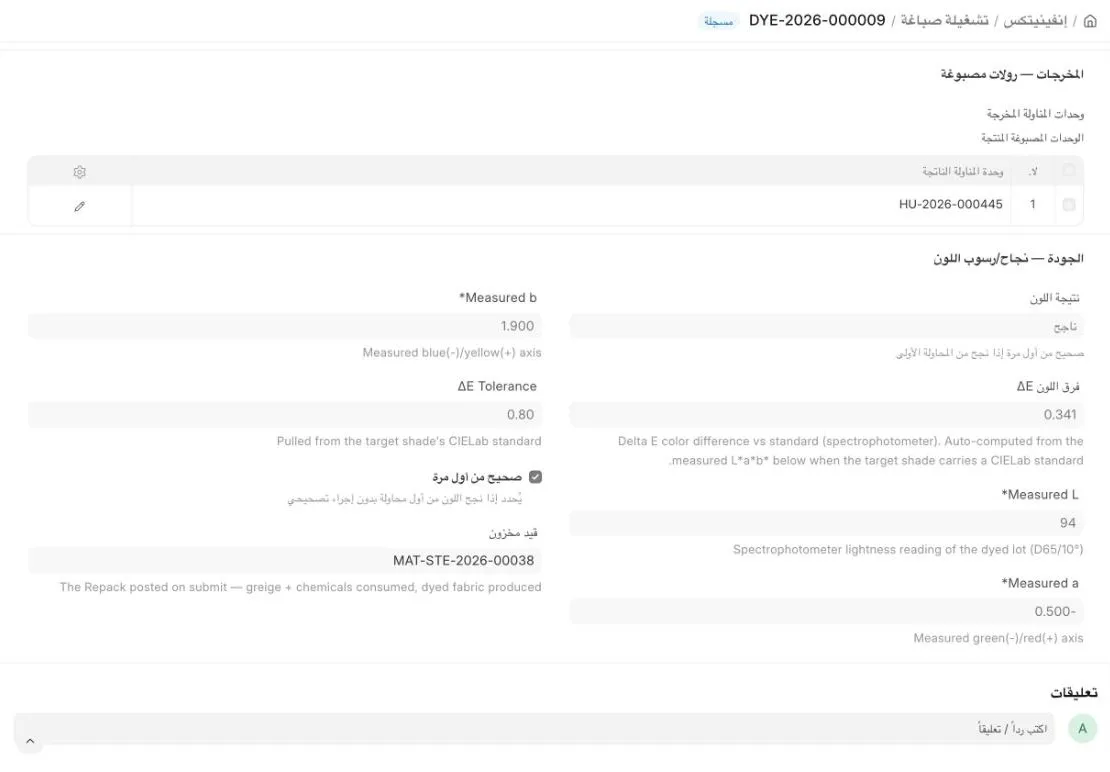
Every shade in the library carries its customer's CIELab standard and ΔE tolerance. The operator keys the spectrophotometer reading on the dye lot and InfiniTex computes the CIEDE2000 color difference on save. Pass means right-first-time. Fail routes to re-dye, strip or topping, with the cost accumulating on the same lineage, so the true cost of a shade includes its failures.
- Recipes exploded to chemical consumption by batch weight and liquor ratio
- Automatic ΔE against the shade standard, with RFT% as a first-class KPI
- Off-shade variants born automatically on the corrective path
Planning: master board
The mill's month on one draggable timeline
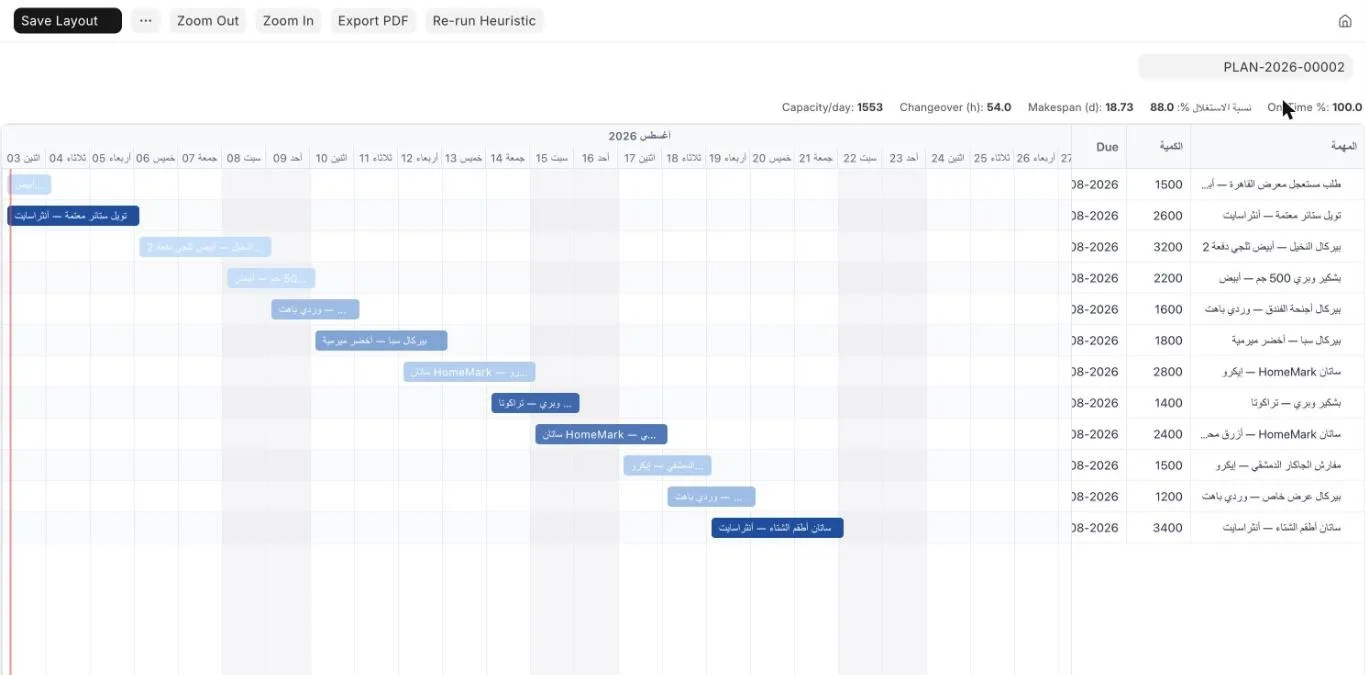
The master planning board sequences the order book on finite capacity with the constraints mills actually feel: dark-after-light shade families, width and reed change penalties, delivery dates. Bars are colored by shade depth, late jobs turn red, and dragging a bar re-plans the schedule with on-time delivery, utilization, makespan and changeover hours re-measured live.
- Shade-aware sequencing that avoids expensive jet cleanings
- Drag-and-drop re-planning with a live KPI strip
- Full RTL Arabic, zoom and PDF export for the morning meeting
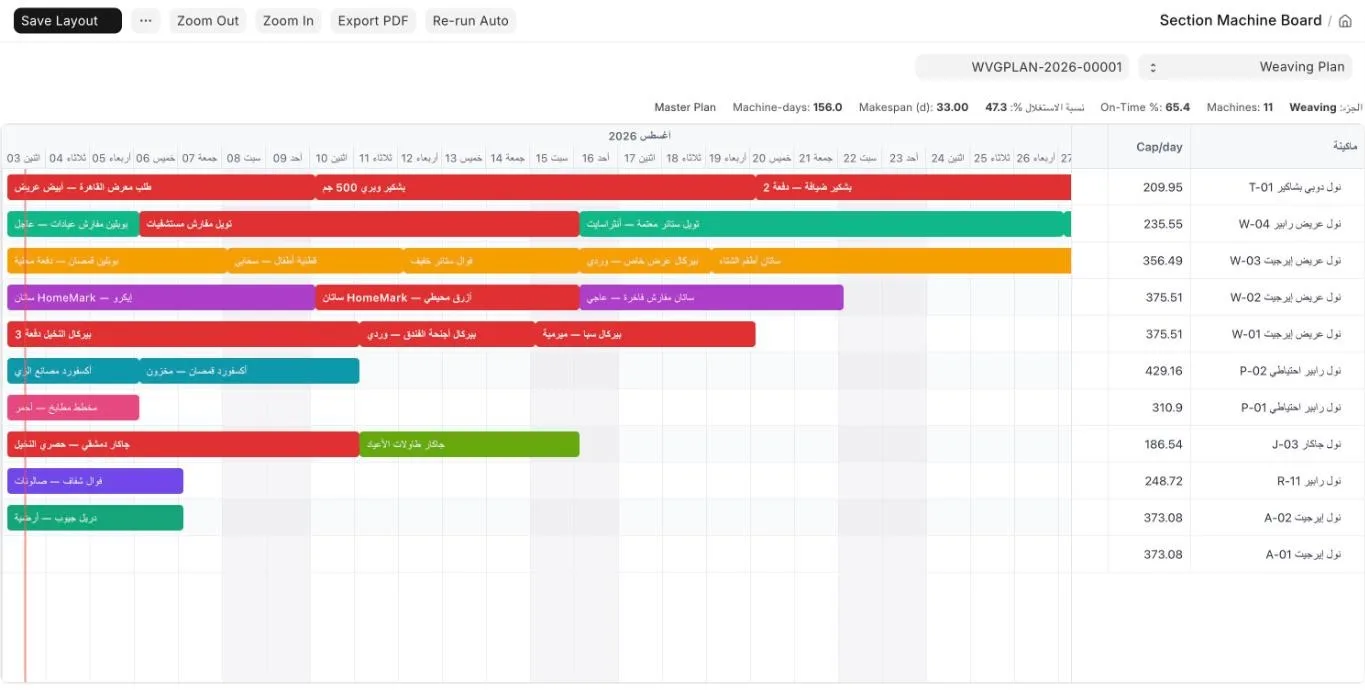
Section planning: machine lanes
Six section boards, down to the single machine
Spinning, warping, weaving, dyeing, garments and embroidery each get their own plan: one lane per machine, one bar per job, scheduled by each machine's real specification (spindles and rpm, creel and ends, looms, jets, SMV and operators). Drag a bar vertically to move a job to another machine, horizontally to reschedule. Every section rolls up to the master plan.
- Machine masters with technical specs drive lane capacity
- Auto-assignment to the least-loaded active machine, honoring priority and due date
- Maintenance and idle machines drop out of the lanes automatically
The kernel: handling units
Bed sheets, towels, curtains. Modelled natively.
InfiniTex was proven on the home-textile continuum: wide-width weaving, hotel whites with instrument-grade color control, defect-aware cutting and monogram embroidery. Every step is a real stock voucher, and every towel is traceable back to its cones.
- Percale 200TC
- Sateen 300TC
- Terry 500 gsm
- Jacquard damask
- Blackout curtains
- Hotel programs
- Bed linen
- Percale and sateen on 340 cm wide airjets, from warp math to fitted-sheet elastication and set packing.
- Terry towels
- 500 g/m² pile constructions, weight and absorbency lab-tested per lot, monogram embroidery for hotel programs.
- Curtains and drapery
- Blackout twills and sheer voiles with defect-aware cut planning that fits panels between faults.
- Table and hospitality linen
- Jacquard damask up to 360 cm reed, customer-exclusive designs, CIELab-controlled hotel whites.
Built for IT to say yes
Beside the ledger, never instead of it.
- 100% ERPNext-native: zero core forks, zero monkey patches, clean upgrades
- Every physical movement posts a native stock voucher, so valuation and closing stay exact
- Quality, compliance and lab records feeding Oeko-Tex, GOTS and EU Digital Product Passport readiness
- Mill-floor Arabic (التسدية، البوش، الدوف) across 1,000+ translated strings, full RTL
- 8 textile roles with granular permissions and document versioning everywhere
- Open-source economics: vertical depth without six-figure licensing
Every mill is different. So is every InfiniTex.
Spinning to garments, single site to multi-company: InfiniTex is scoped and priced around your processes and your machine park. Talk to us and we'll walk you through a live demo mill, from yarn cone to monogrammed hotel towel, and put together a proposal for your operation.
Or write to info@infinitysys.org. We usually reply within one business day.